Imagine a software developer who writes a bug‑fix, runs the test suite, and then hands the patch to a teammate. The patch is concise, readable, and only contains the changes that actually matter. Contrast that with a patch produced by a state‑of‑the‑art coding agent: the tests pass, but the file has become bloated with dozens of superfluous edits that the agent tried, abandoned, and never really needed. Developers have reported that such “AI‑generated code slop” (CODESLOP) makes reviewing, understanding, and maintaining code harder than ever.
This is not a fringe issue. As coding agents become mainstream — fixing bugs, building libraries, and prototyping — the volume of unnecessary code is growing faster than human-written code. The paper TRIM: Reducing AI‑Generated CODESLOP via Agent Trajectory Minimization tackles this problem head‑on by redefining what “slop” means in the context of AI agents and introducing a lightweight, trajectory‑guided algorithm that cuts it by up to a third.
Background
The Rise of Coding Agents
Modern AI agents can:
- Navigate a codebase — understanding file hierarchies, import graphs, and API contracts.
- Generate code — from scratch or by editing existing files.
- Run tests — iteratively refining their edits until the test suite passes.
In domains like program repair, an agent repeatedly edits a buggy file, runs the tests, and stops only when all tests succeed. This loop is called a repair trajectory.
Where the Problem Lies
Early studies focused on whether a patch passes the tests. Yet passing a test does not guarantee that the patch is minimal or clean. The agent’s internal search process leaves behind:
- Speculative edits that were later discarded.
- Temporary changes that only existed while the agent explored.
- Redundant boilerplate added to satisfy the model’s training bias.
These remnants accumulate over time, turning a once‑minimal codebase into a tangled mess. Existing metrics — verbosity, duplication, cyclomatic complexity — capture static slop but fail to tell whether a change is actually necessary for the bug fix.
Key Innovation
Defining CODESLOP Functionally
The authors propose a functional definition:
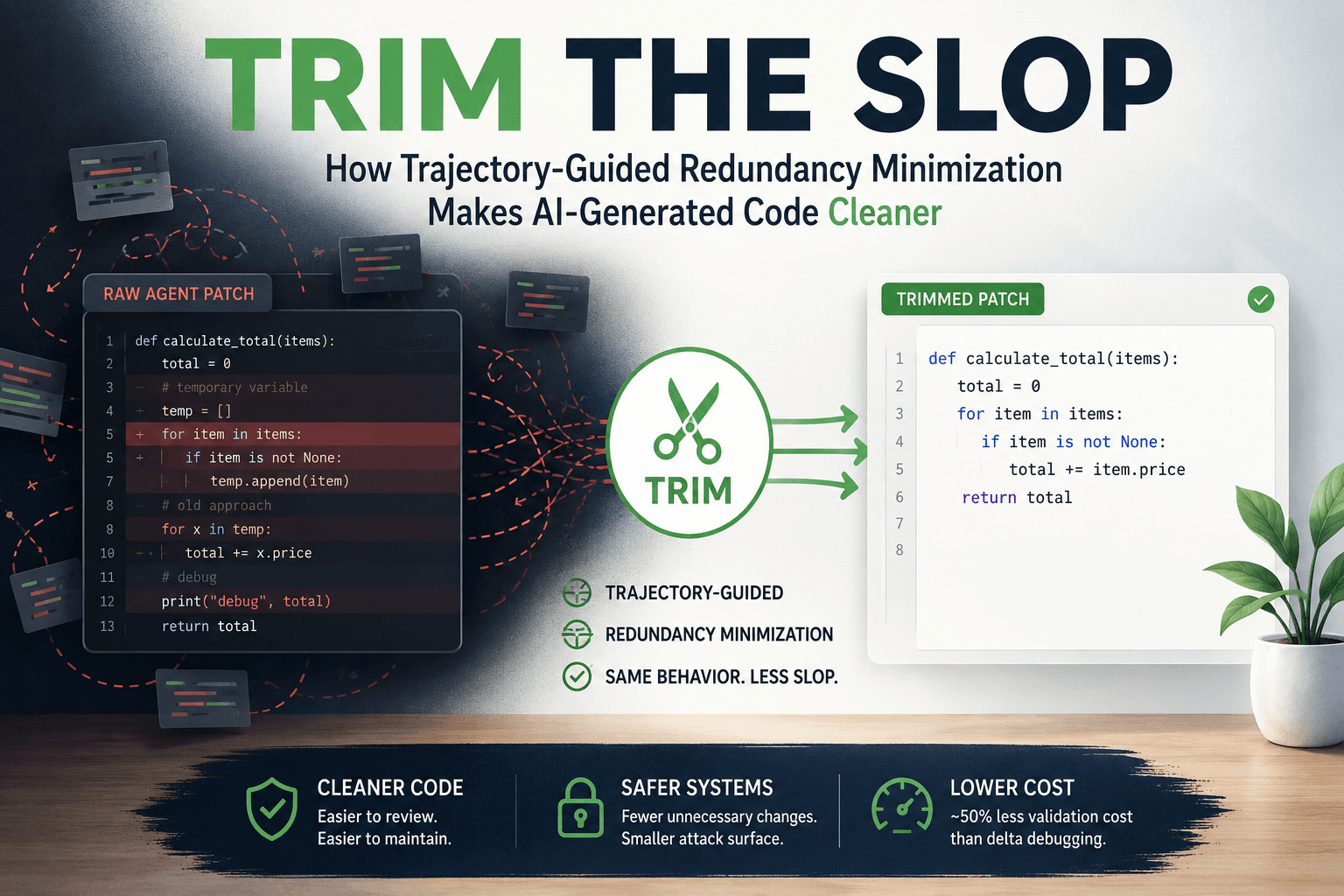
CODESLOP is removable functional redundancy — changes introduced during the agent’s search that can be deleted without affecting the final passing test suite.
This perspective shifts the focus from how the code looks to what it does.
Trajectory‑Guided Redundancy Minimization (TRIM)
Instead of hunting for unnecessary edits in the final patch, TRIM looks at the entire repair trajectory. Think of the trajectory as a breadcrumb trail that records every edit the agent made. By examining this trail, TRIM can infer dependencies between edits:
- Coarse‑grained pruning — ask whether a group of edits can be removed. If the tests still pass, the whole group is dropped.
- Fine‑grained pruning — if a group fails, split it further and test smaller sub‑groups.
- Hierarchical counterfactual search — each step is a counterfactual: “What if we removed these changes? Would the patch still work?”
Because the trajectory already encodes the temporal order, the algorithm can reason about why an edit was made and whether it is essential.
Why It Works
- Indirection — By focusing on the search process rather than the final artifact, TRIM avoids the combinatorial explosion of testing every subset of the final patch.
- Efficiency — Each removal attempt is validated by running the test suite. Since many groups are pruned early, the number of expensive validations is halved compared to classic delta debugging.
- Minimal performance impact — The algorithm rarely changes the behavior of the patch; it simply removes dead code.
Results & Impact
MetricBaseline (Unpruned)TRIMΔ (Reduction)CODESLOP lines2114–32.9 %CODESLOP lines1512–20 %CODESLOP lines1210–16.7 %Test pass rate100 %100 %–Validation cost1×0.5×–
- Across multiple agent scaffolds (e.g., SWE AGENT, Codex‑based repair), TRIM consistently cuts CODESLOP by 17.9 %–32.9 %.
- The algorithm’s validation cost is roughly half that of delta debugging, a standard but heavyweight baseline.
- Importantly, the patches remain functionally identical; no regression is observed.
“TRIM demonstrates that a trajectory‑guided approach can prune unnecessary edits efficiently, without sacrificing correctness.” — TRIM authors
Implications
Cleaner Codebases
Removing CODESLOP means:
- Smaller patches that are easier to review.
- Reduced cognitive load for developers who must understand the change.
- Faster merge times and fewer conflicts.
Security & Reliability
In safety‑critical systems (e.g., kernel patches, medical software), any extraneous code is a potential attack surface. By ensuring that only the necessary edits survive, TRIM contributes to secure-by‑design practices.
Future Directions
- Extending to multi‑file changes — current work focuses on single‑file patches; future work could handle cross‑module dependencies.
- Learning‑based pruning — integrating a lightweight model that predicts which edits are likely redundant.
- Real‑time integration — embedding TRIM into continuous‑integration pipelines so that agents produce clean patches out of the box.
Conclusion
The TRIM paper shows that the way an AI agent explores a codebase matters just as much as the final result. By redefining CODESLOP functionally and leveraging the agent’s repair trajectory, the authors deliver a simple yet powerful algorithm that trims unnecessary code by up to a third — without extra cost or risk.
For developers, this means cleaner patches and smoother code reviews. For researchers, it opens a new avenue: trajectory‑guided optimization can be applied beyond program repair, perhaps to AI‑driven refactoring or automated documentation.
Takeaway: When an AI agent finds a solution, let it forget the detours it took. TRIM shows how to do that efficiently.
If you’re building or using coding agents, consider integrating TRIM into your workflow. Cleaner code is not just nicer — it’s safer, faster, and ultimately more maintainable.
Paper Link: https://arxiv.org/pdf/2607.18161