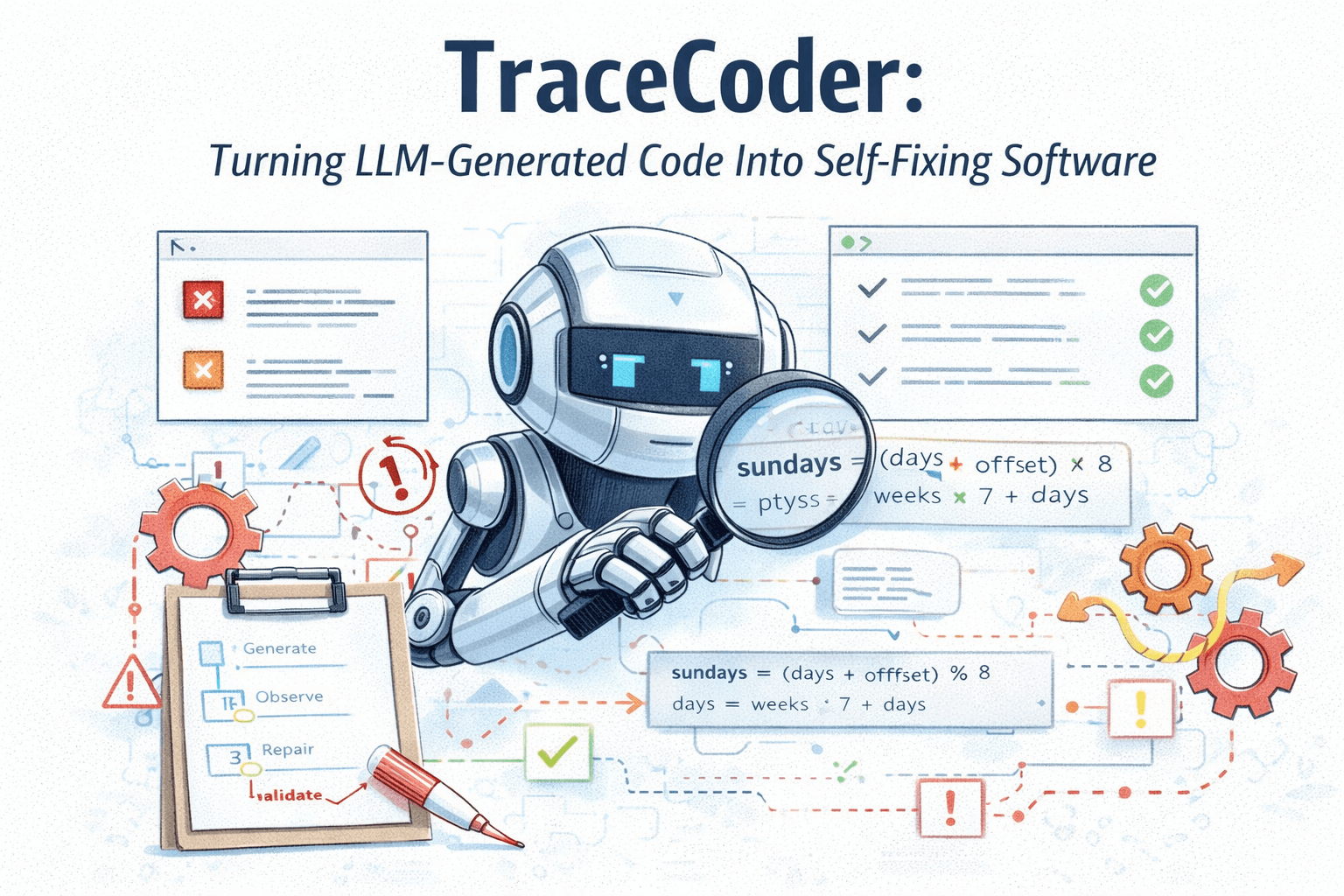
In 2026, a team of researchers from China and Singapore introduced TraceCoder, a multi‑agent system that gives large language models (LLMs) a runtime microscope. By instrumenting code, analyzing causal traces, and learning from past failures, TraceCoder turns the brittle, black‑box debugging approaches of today into a disciplined, iterative repair process. The result? A 34 % boost in Pass@1 accuracy over the state of the art and a new paradigm for self‑debugging software.
1. Introduction
Large language models have become the go‑to assistants for writing code. Yet, their output is far from perfect: a missing semicolon, an off‑by‑one error, or an incorrect algorithmic assumption can lead to subtle bugs that only surface during execution. Traditional automated repair methods treat the LLM as a black box that receives a pass/fail signal from a test suite and then tries to rewrite the code. Without deeper visibility into why a test failed, these methods often:
- Break existing correct logic (performance degradation).
- Loop on local fixes that never converge to a globally correct solution (fixation & stagnation).
TraceCoder addresses these pain points by mimicking the human debugging workflow: observe → analyze → repair. It equips the LLM with diagnostic probes, performs causal analysis on execution traces, and incorporates a historical lesson‑learning mechanism to avoid repeating past mistakes.
2. Background
The Rise of LLM‑Assisted Development
- Code generation: GPT‑4, Codex, and other LLMs can produce syntactically correct code for a wide range of tasks.
- Code summarization & transformation: Models can explain, refactor, or translate code snippets.
- Automated repair: Recent studies (e.g., CoT prompting, statistical fault localization, multi‑agent synergies) have tried to let the LLM fix its own mistakes.
Gaps in Current Approaches
No runtime insight: Fault localization is superficial; the model may patch the wrong line.
Stateless repair: Each iteration starts fresh; the model cannot remember what failed before.
Inefficient loops: The model may keep applying the same local patch, degrading overall correctness.
These shortcomings make automated debugging of LLM‑generated code a frustrating, error‑prone process.
3. Key Innovation
A Trace‑Driven, Multi‑Agent Architecture
- Instrumentation Layer Adds diagnostic probes to the generated code. Think of it as sprinkling debugging sensors throughout a circuit: each probe records variable values, function calls, and branching decisions.
- Causal Analysis Module Runs a lightweight causal inference engine on the collected trace. It asks questions like, “Which variable change caused the assertion to fail?” and pinpoints the root cause rather than just the symptom.
- Historical Lesson Learning Mechanism (HLLM) Stores insights from previous repair attempts. If the model previously fixed a similar off‑by‑one error in a different function, HLLM recommends the same strategy, preventing redundant work.
- Rollback Mechanism Guarantees that every repair iteration improves the code. If a patch introduces a new bug, the system reverts to the last known good version, ensuring monotonic progress.
How It Works in Practice
- Generate — The LLM produces an initial implementation.
- Observe — The code runs under test, and probes capture a fine‑grained trace.
- Analyze — The causal module identifies the faulty line or logic.
- Repair — The LLM, guided by HLLM, generates a patch.
- Validate — The patched code runs again; if it passes, the process stops; otherwise, it repeats.
This cycle mimics how a human developer uses a debugger: breakpoints, step‑through, and incremental fixes.
4. Results & Impact
Benchmark Performance
MetricBaselineTraceCoderPass: @145.1% 61.4%
Relative Improvement: +34.43%
Cost‑Efficiency: Higher iteration costLower average iterations
- Ablation studies show that the iterative repair process alone yields a 65.61% relative gain, underscoring the power of the multi‑agent loop.
- TraceCoder outperforms leading iterative methods not only in accuracy but also in computational cost, thanks to its rollback and HLLM features.
Qualitative Insights
- Root‑cause precision: In a test case where the function
fmis‑computed the days until Sunday, TraceCoder traced the error to a mis‑applied modulo operation and suggested the correct7 - indexformula. - Learning from history: When encountering a similar off‑by‑one bug in a different function, HLLM recalled the earlier fix and applied it immediately, cutting down the number of iterations.
5. Implications
For Research
- Bridging the gap between black‑box and white‑box debugging: TraceCoder demonstrates that adding runtime introspection to LLM pipelines yields tangible gains.
- New avenues for causal inference in software repair: The causal module can be extended to more complex program analyses, such as data‑flow or control‑flow debugging.
For Practice
- Productivity boost: Developers can rely on LLMs to generate code that self‑corrects, reducing manual debugging time.
- Safety in mission‑critical systems: The rollback mechanism ensures that each repair iteration is a guaranteed improvement, a property desirable in safety‑critical software.
Future Directions
- Domain‑specific probes: Customizing instrumentation for languages like Rust or functional languages.
- Interactive debugging: Allowing human developers to intervene at any step, combining human intuition with automated reasoning.
- Scaling to large codebases: Extending TraceCoder’s approach to multi‑module projects with interdependencies.
6. Conclusion
TraceCoder turns the black‑box nature of LLM‑generated code into a transparent, iterative debugging process. By adding diagnostic probes, causal analysis, and a memory of past failures, it transforms the LLM from a “guess‑and‑try” model into a disciplined, self‑learning repair agent.
Why should you care? As LLMs become embedded in every coding workflow, the ability to automatically correct their mistakes will become a core competence of modern software engineering. TraceCoder shows that runtime insight and historical learning are the keys to unlocking this potential.
If you’re building tools that rely on LLMs for code generation, consider integrating a trace‑driven repair loop. The next time your model produces a buggy function, you’ll have a microscope, a detective, and a seasoned mentor all in one system.