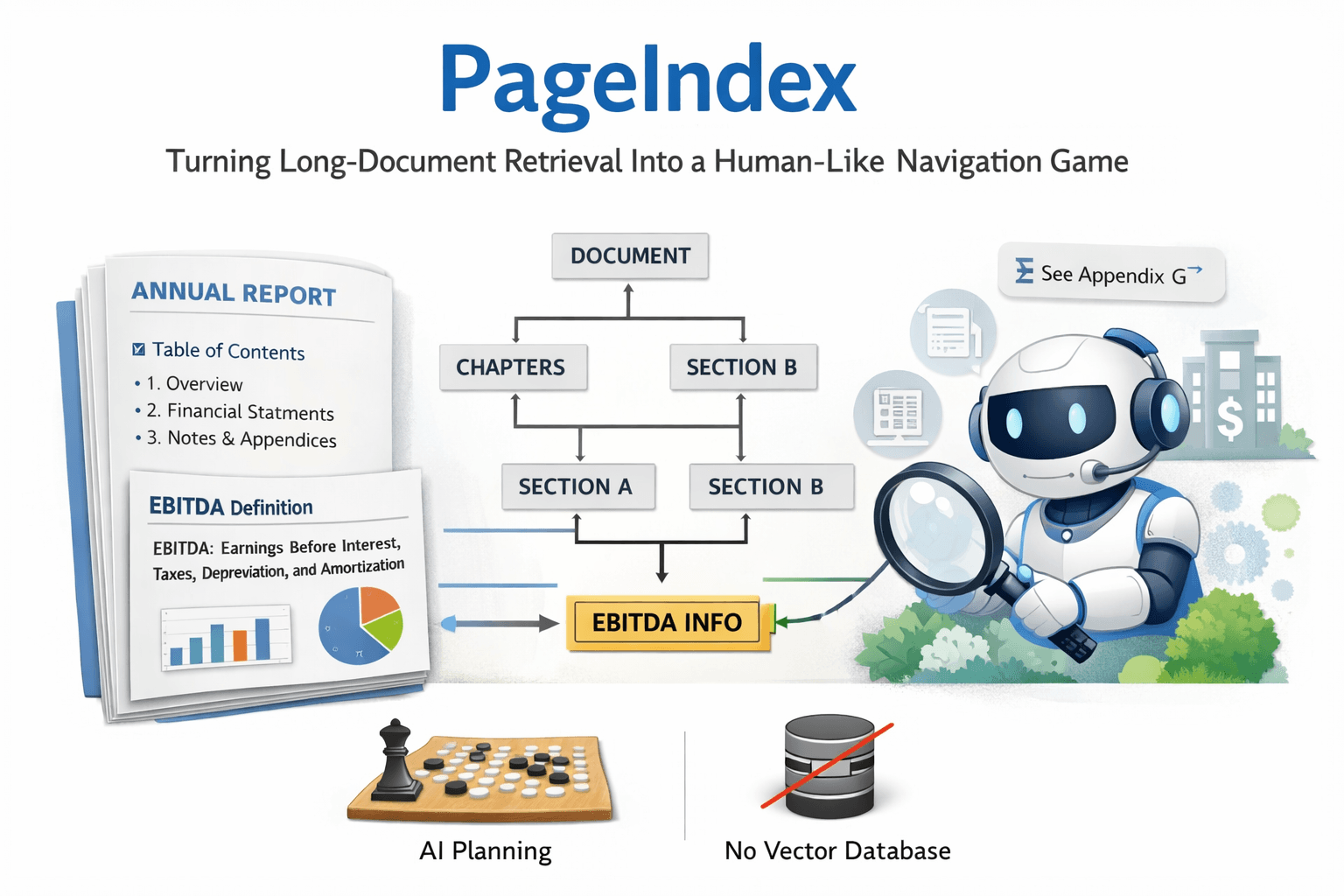
Imagine trying to find the definition of “EBITDA” in a 200‑page annual report. A human would flip to the table of contents, skip to the “Financial Statements” chapter, and then drill down to the section that actually defines the term. A traditional retrieval‑augmented generation (RAG) system, however, simply looks for the most semantically similar text chunk, often pulling every mention of “EBITDA” and drowning the user in irrelevant passages.
Ben Dickson’s 2026 feature on PageIndex tackles this mismatch head‑on by rethinking retrieval as navigation rather than search. The result is a framework that lets large language models (LLMs) plan where to look — much like a game‑playing AI — while keeping the process lightweight enough for enterprise use.
Background
The RAG Landscape
RAG has become the de‑facto standard for augmenting LLMs with external knowledge. The classic pipeline is:
- Chunk documents into fixed‑size segments.
- Embed each chunk with a vector model.
- Store vectors in a database.
- At inference time, retrieve the top‑matching chunks by semantic similarity.
- Feed the retrieved text into the LLM to generate an answer.
This workflow works well for short documents or simple Q&A tasks. But it struggles when documents are long, highly structured, or require multi‑hop reasoning — the ability to follow references across sections.
The Missing Piece
Enterprise use cases — auditing financial statements, dissecting legal contracts, navigating pharmaceutical protocols — demand more than semantic proximity. They require:
- Intent‑aware retrieval: distinguishing between a casual mention of a term and the precise definition or calculation.
- Context preservation: incorporating the conversation history into the retrieval step.
- Structural awareness: following cross‑references, footnotes, and appendices that a vector model might ignore.
Before PageIndex, engineers had to tinker with chunk sizes, add hand‑crafted rules, or build custom pipelines. No single, open‑source solution addressed all these pain points simultaneously.
Key Innovation
From Chunk‑And‑Embed to Tree‑Search
PageIndex abandons the “chunk‑and‑embed” paradigm entirely. Instead, it builds a Global Index — a tree that mirrors the document’s table of contents:
- Root node: the document title.
- Intermediate nodes: chapters, sections, subsections.
- Leaf nodes: individual pages or small blocks of text.
When a query arrives, the LLM performs a tree search:
- Classify each node as relevant or irrelevant based on the full context of the user’s request.
- Navigate deeper only into nodes marked relevant.
- Retrieve the precise text once the search reaches the desired leaf.
“PageIndex applies the same core idea — tree search — to document retrieval, and can be thought of as an AlphaGo‑style system for retrieval rather than for games.” — Mingtian Zhang, co‑founder of PageIndex
This approach mirrors how humans read: we use the table of contents to locate the chapter, then the section, then the page. The LLM becomes an agentic navigator rather than a passive fetcher.
Architectural Shifts
- No vector database: The tree can be stored in a lightweight relational database (e.g., PostgreSQL).
- Inline retrieval: Retrieval happens during generation, so the first token is streamed immediately — Time to First Token (TTFT) remains comparable to a vanilla LLM call.
- Incremental re‑indexing: Editing a contract’s clause only requires re‑indexing the affected subtree, not the entire corpus.
Results & Impact
FinanceBench Benchmark
Using PageIndex, the system Mafin 2.5 scored 98.7 % on the FinanceBench multi‑hop reasoning benchmark — setting a new state‑of‑the‑art. The gap versus traditional vector‑based RAG was stark:
- Vector RAG: Struggled with queries that required following footnotes or cross‑references.
- PageIndex: Followed structural cues (e.g., “See Appendix G”) to locate the correct data.
Key Findings
- Intent vs. Content Gap: Vector retrieval conflates any mention of a term with relevance, whereas PageIndex disambiguates by context.
- Latency Management: Despite the LLM doing more work, the perceived latency stays low because retrieval is integrated into generation.
- Infrastructure Simplification: Enterprises avoid maintaining costly vector stores and the sync overhead associated with live documents.
Implications
When to Use PageIndex
Document TypeIdeal Retrieval MethodWhyEmails / Chat logsNone (fits in LLM context)Entire text is already availableShort, unstructured textVector RAGSemantic similarity is sufficientLong, highly structured documents (annual reports, legal contracts, FDA filings)PageIndexRequires deep navigation and auditability
Potential Applications
- Financial auditing: Quickly locate precise definitions or calculations across a company’s filings.
- Legal review: Follow clause references and footnotes to ensure compliance.
- Regulatory science: Navigate complex pharmaceutical protocols and appendices.
Future Directions
- Hybrid Retrieval: Combining tree‑search for structural navigation with vector retrieval for semantic discovery.
- Agentic RAG: As LLMs gain more planning capabilities, the line between retrieval and generation will blur further.
- Cross‑document Navigation: Extending the tree concept to link related documents (e.g., a contract and its amendments).
Conclusion
PageIndex reimagines retrieval for long documents as a human‑like navigation problem rather than a static search. By embedding the document’s structure into a tree and letting an LLM act as an agentic navigator, it resolves the intent‑vs‑content gap, preserves conversational context, and dramatically improves accuracy on multi‑hop queries — all while keeping latency and infrastructure demands modest.
For enterprises moving RAG into high‑stakes workflows, PageIndex offers a clear path to auditability, precision, and simplicity. As LLMs continue to evolve, frameworks that shift responsibility from database to model — what some call Agentic RAG — will likely become the new standard.
“PageIndex does not add an extra retrieval gate before the first token, and Time to First Token (TTFT) is comparable to a normal LLM call.” — Mingtian Zhang
What’s next for your organization? Consider whether your most critical documents are long and structured enough to benefit from a tree‑search approach, and explore how integrating PageIndex could elevate the reliability of your AI‑powered decision tools.